
AI-Generated Visuals: Copyright and Commercial Use Risk Map for Brands
Learn how to manage copyright and commercial-use risks in AI-generated visuals with a practical framework for marketing teams.
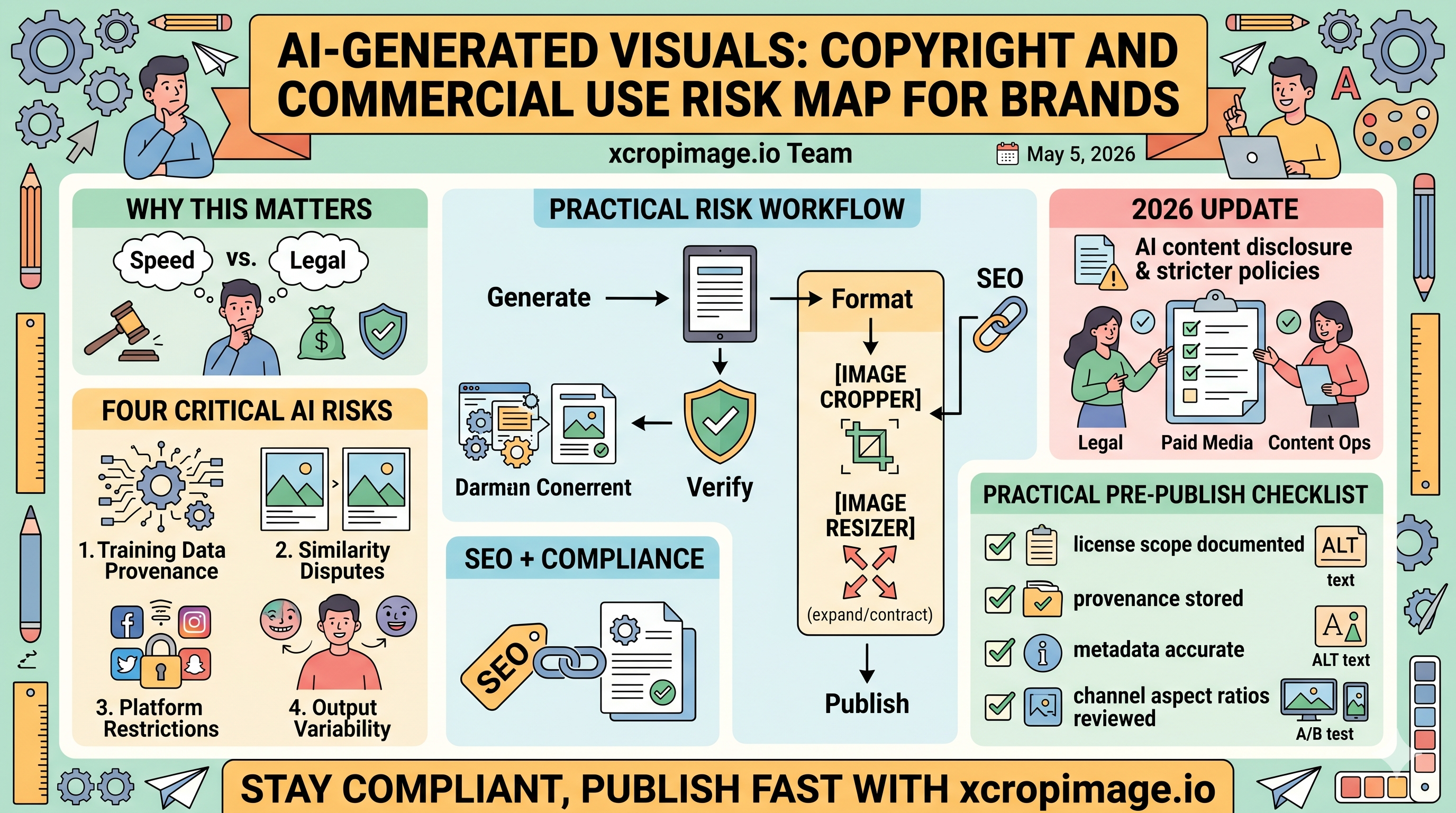
Why This Matters
AI visuals help teams ship faster, but speed without legal clarity creates hidden costs. If a campaign image is challenged for similarity or licensing ambiguity, you may lose ad budget, trust, and publishing momentum at the same time.
Four Risks You Should Track
- Unclear training data provenance, 2) similarity disputes, 3) platform-specific usage restrictions, and 4) output variability across model versions.
These are not edge cases anymore; they are routine operational concerns for content teams.
For metadata consistency and search visibility, align your filenames and alt text with a fixed rule set. This guide on e-commerce file names and alt text is a good baseline.
Build a Practical Risk Workflow
Create a lightweight record for every image: model/source, intended usage, and license note. Add this as a mandatory checkpoint before publishing. If the same creative runs across different placements, standardize aspect ratios with the image cropper and generate channel-specific sizes using the image resizer.
SEO + Compliance Can Work Together
Teams often treat legal review and SEO as separate tracks. They should be connected: the page topic, alt text, and visual context must tell the same story. For delivery performance, pair this process with modern format choices from WebP format advantages.
Final Takeaway
AI visuals are powerful when governed. The winning approach is simple: create fast, document clearly, verify before launch, and publish with channel-ready assets.
2026 Update: What Teams Are Changing
In 2026, major distribution channels are moving toward stronger AI-content disclosure and stricter policy enforcement in sensitive categories. That means visual approval cannot stay inside design only; legal, paid media, and content operations must share one release checklist.
Practical Pre-Publish Checklist
- Is the commercial-use scope explicitly documented?
- Is model/version provenance stored with the asset?
- Does metadata accurately reflect what the image shows?
- Are channel-specific aspect ratio versions exported and reviewed?
For scalable execution, combine this with a repeatable batch workflow, then generate production-ready outputs using the image cropper and image resizer.